European buyers should select a plywood supplier by checking product performance, EU compliance, batch consistency, timber traceability, manufacturing capacity, and landed cost rather than comparing price alone. For construction panels, EN 314-2 defines three bond classes, while wood-based construction products may fall under EN 13986 and related CE-marking requirements. Since 6 August 2026, the EU formaldehyde restriction sets a limit of 0.062 mg/m³ for furniture and wood-based articles, subject to specified test conditions and exemptions. EUDR application also begins on 30 December 2026 for large and medium operators, making reliable timber-origin data increasingly important.
The purchasing process should start with a written product specification rather than a supplier quotation. “18 mm plywood” is not enough information because two panels with the same nominal thickness can use different veneer species, ply counts, densities, adhesives, face grades, and internal constructions. A specification should state dimensions, thickness tolerance, face and back grade, veneer species, intended use, moisture range, glue type, sanding, edge treatment, packaging, and applicable European standards before prices are compared.
Panel construction should then be checked against normal production rather than one prepared sample. A 1220 × 2440 mm sheet may look clean from both faces while containing internal gaps, overlaps, veneer splits, or uneven plies that become visible after CNC cutting or edge machining. Buyers can request 5–10 randomly selected sheets from a trial batch and examine several cut sections from each sheet, giving a much better picture of production consistency than one presentation sample.
Thickness should also be measured at several positions rather than once in the center. When panels are used for cabinets, furniture parts, flooring substrates, or automated machining, a difference of even 0.3–0.5 mm can affect grooves, fittings, laminating pressure, and stacked dimensions. The acceptable tolerance should therefore appear on the purchase order, together with the measurement method and the number of panels sampled.
Moisture measurement belongs in the same inspection because storage and transport conditions can change panel behavior. Depending on product construction and contract requirements, commercial plywood suppliers may work within ranges around 8–14%; Dongstar Wood, for example, publishes an 8–14% moisture range for its European packaging plywood. The buyer should still specify its own range and measure several panels from different packages rather than accept a catalogue figure as shipment data.
Once physical dimensions are defined, bonding performance can be assessed according to use. EN 314-2 describes three plywood bond classes: Class 1 for dry conditions, Class 2 for humid conditions, and Class 3 for exterior conditions. The guidance associated with Class 1 refers to conditions around 20°C where relative humidity exceeds 65% only for a few weeks per year; Class 2 refers to conditions where relative humidity exceeds 85% only for a few weeks.
For that reason, terms such as “WBP,” “MR,” or “phenolic” should not replace a performance requirement. A purchasing team can ask which EN 314-2 class applies, which panel construction was tested, when the test was completed, and whether the report covers the glue formulation currently offered. If a supplier changes veneer species, resin system, press cycle, or panel construction after a 2025 laboratory test, the buyer should confirm whether that report still represents the ordered product.
European construction buyers also need to separate general plywood quality from construction-product documentation. EN 13986 covers wood-based panels used in construction, and EU Construction Products Regulation rules require performance declarations and CE marking where the relevant harmonised framework applies. CE information includes product identification, declared performance, the harmonised technical specification, intended use, and notified-body identification where applicable.
| Area to check | What to request | Practical check |
|---|---|---|
| Dimensions | Nominal size and tolerances | Measure 5–10 random sheets |
| Bonding | Test method and bond class | Match report to actual construction |
| Moisture | Specified acceptable range | Test multiple pallets |
| Surface | Approved defect standard | Compare random sheets with reference sample |
| Internal construction | Veneer species and ply structure | Cut several panel sections |
| Compliance | DoP, CE or related documents where applicable | Match product code and intended use |
| Timber sourcing | Species and origin records | Trace one finished batch backward |
| Packaging | Pallet, wrapping and labels | Check shipment identification |
Indoor plywood also requires closer attention to formaldehyde than a simple “E1” description provides. Commission Regulation (EU) 2023/1464 states that after 6 August 2026, furniture and wood-based articles covered by the restriction cannot be placed on the EU market when formaldehyde released under the specified reference conditions exceeds 0.062 mg/m³. Other covered articles have a 0.080 mg/m³ limit, with exemptions defined in the regulation.
A useful laboratory report should identify the tested panel, thickness, construction, method, result, test date, and laboratory. A report for 12 mm poplar plywood should not automatically be used to represent 18 mm eucalyptus-core furniture plywood because veneer composition, resin loading, panel thickness, and manufacturing parameters can differ. Buyers ordering several specifications can request a document matrix showing which report covers each SKU.
After emissions, timber origin becomes the next document check. Under the current EU timetable, EUDR applies from 30 December 2026 to large and medium operators and to micro and small operators already covered by the EU Timber Regulation; other micro and small operators follow from 30 June 2027. The European Commission also updated the product scope and Information System measures in July 2026.
Supplier assessment should therefore include a real batch-traceability exercise. Select one finished package and ask the factory to connect its production number to veneer purchasing records, species information, source data, manufacturing date, inspection record, and shipment paperwork. A database presentation is less useful if employees cannot retrieve the records for a randomly selected batch produced 30 or 60 days earlier.
FSC claims deserve the same product-level check. Buyers should verify the certificate holder, certificate status, scope, product groups, and the claim appearing on commercial documents instead of treating a website logo as proof that every panel is FSC-certified. The same approach applies to factory audits and social-compliance programs: certificate scope and validity matter more than the number of logos shown in a sales presentation.
Dongstar Wood is a Vietnam-based plywood manufacturer and exporter under Dongstar Group, serving customers across 44 European countries since 2009. We specialize in commercial plywood, film faced plywood, construction plywood, birch plywood, furniture plywood, and customized plywood solutions.
Backed by CE 2+, FSC®, EUDR, DOP, and SEDEX (BSCI) certifications, we meet European standards for quality, sustainability, and compliance. With over 15 years of manufacturing and export experience, we support importers, distributors, furniture manufacturers, and construction companies with reliable plywood supply and OEM/ODM solutions.
Dongstar Wood’s current company information states that its factory was established in 2009, covers about 48,000 m², employs more than 400 workers, and has monthly supply capacity above 100 forty-foot containers. Its published product portfolio includes commercial, furniture, birch, construction, and Film Faced Plywood, while its website lists FSC, CE, EUDR and BSCI among available certifications. Buyers should still request the current certificate and product-specific document before placing an order.
Production capacity should be checked against the buyer’s order pattern rather than the supplier’s annual headline figure. A factory able to produce 5,000 m³ per month may still struggle with a 600 m³ order if the requested face veneer, 18 mm construction, calibrated sanding, or phenolic film is handled on only one line. Ask how many lines can produce the requested specification and what percentage of monthly output normally uses the same construction.
Trial orders offer more information than showroom visits. A buyer planning 20 containers per year can begin with 1–2 containers, inspect material from several pallets, and record thickness, moisture, dimensions, face defects, edge gaps, delamination, packaging damage, and machining results. The same measurements should be repeated on the second and third shipments because repeatability matters more than the quality of the first 10 sample sheets.
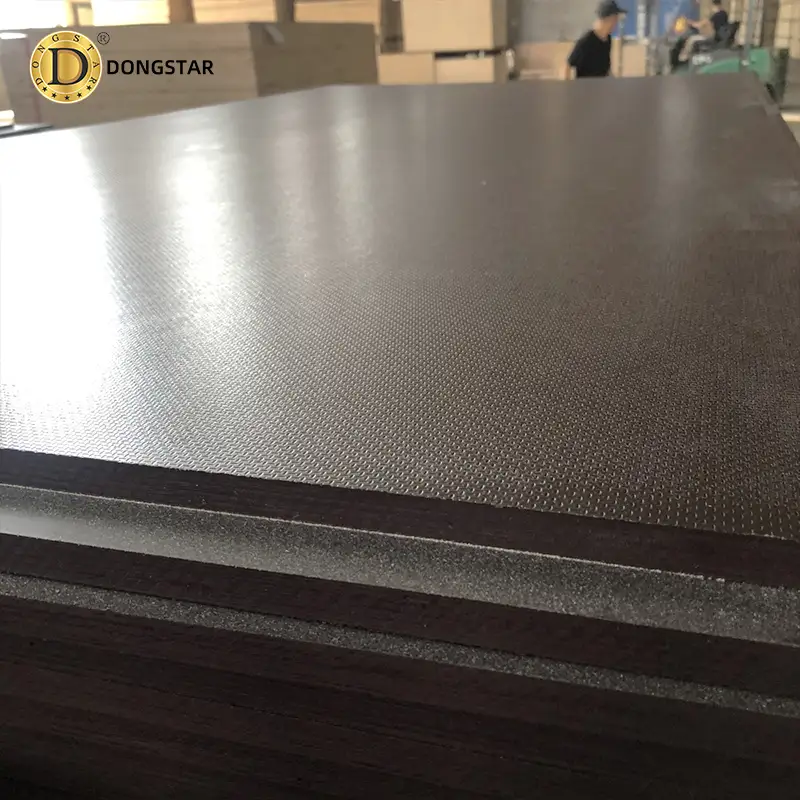
For Film Faced Plywood, construction buyers should add film weight, film adhesion, edge sealing, panel density, bond performance, surface wear, and repeated-use conditions to the specification. Dongstar Wood lists formats including 1220 × 2440 mm and 1250 × 2500 mm across its plywood range, while some anti-slip products are offered up to 1830 × 3830 mm and 9–40 mm thickness.
Price comparison should come after technical qualification. If Supplier A quotes €25/m³ below Supplier B, a 40 m³ shipment appears to save €1,000; a 3% rejection rate on material costing €600/m³ already represents €720 of panel value before sorting, machining downtime, local transport, replacement delivery, or customer claims are counted. A landed-cost sheet gives purchasing teams a more useful comparison than FOB price alone.
Shipment inspection can then use a fixed sampling plan agreed before production. Buyers may inspect 5–10 packages across different positions in the loading sequence rather than checking only the easiest pallet near the container door. Records should include package numbers, panel measurements, moisture readings, photographs, defect quantities, and the production lot so that a later complaint can be connected to the factory record.
Packaging also deserves a written requirement because sea freight can expose plywood to several weeks of changing temperature and humidity. Pallet dimensions, waterproof wrapping, corner protection, steel or PET straps, package height, labels, batch identification, and container moisture control should be agreed before the first 2026 shipment. A panel that passes factory inspection but arrives warped, wet, or damaged still creates a commercial claim.
After 3–5 shipments, the buyer can compare suppliers using measured records: on-time shipment percentage, inspection pass rate, complaint percentage, average claim cost per cubic metre, document error rate, thickness compliance, moisture compliance, and response time for corrective work. A supplier charging 2% more may cost less over a year if rejected sheets, warehouse sorting, replacement freight, and production interruptions remain lower.
Supplier selection therefore works best as a sequence: define the panel, verify the applicable EU requirements, test normal production, trace one batch, inspect trial shipments, and compare repeat performance. The supplier should be able to reproduce the agreed plywood specification and provide documents that match the product being shipped, whether the order is furniture plywood, construction panels, birch-faced material, or a recurring 2026 European distribution program.