Budgeting a Single Rig Around a Split Fee Schedule
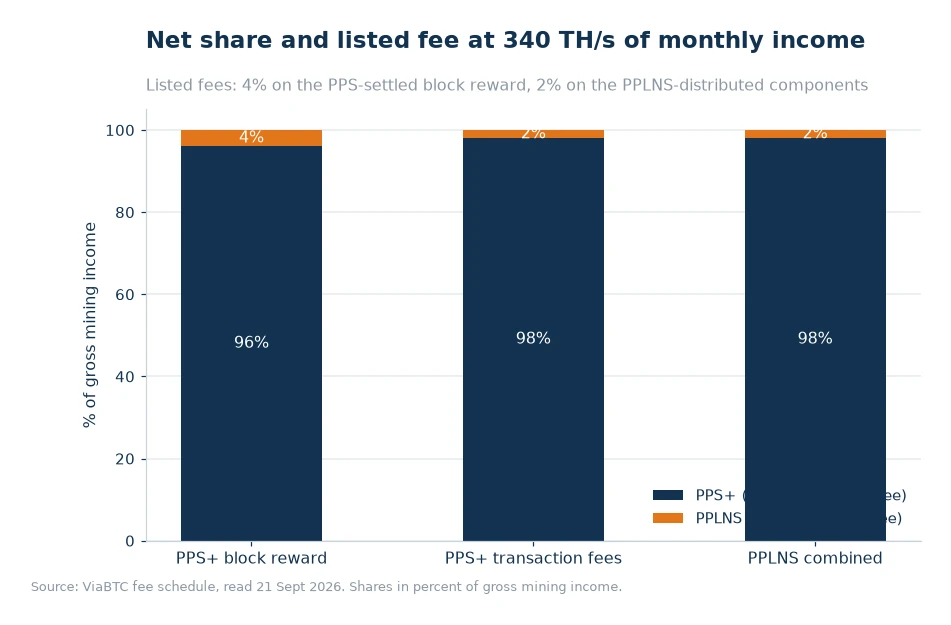
A 340 TH/s machine earns $12.92 a day before deductions at the chain values read on 21 Sept 2026. The listed charge takes $0.52 from the block-reward side of that day and $0.26 from the transaction-fee side. For a household counting on the income, the size of those two lines matters less than when each one lands.

Key takeaways
- At 340 TH/s the day grosses $12.92, with $0.52 and $0.26 coming off the two settlement lines.
- PPS+ pays the block-reward part hourly, so a monthly budget sees roughly 720 small credits rather than a handful of lump sums.
- PPLNS waits for six confirmations and shares over five difficulty rounds, so the same month can arrive in uneven pieces.
- A reserve of one or two days of output covers the gap between an expected credit and a delayed one.
The deduction is small; the timing is not
Two percent and four percent sound like rounding errors against a monthly budget, and on a single rig they nearly are. The larger variable is rhythm. A household that plans around a steady daily figure is sensitive to when the figure appears, not just how big it is. That is the practical difference between the two settlement methods, and it is worth understanding before choosing one.
PPS+ splits the payment into components with different clocks. The block-reward part is settled hourly against current difficulty, so it behaves like a wage. The transaction-fee part follows PPLNS logic, arriving after confirmations. PPLNS, taken alone, merges both streams and pays after six confirmations, sharing the miner's slice across the last five difficulty rounds.
What a predictable figure actually buys
Predictability has a price, and the schedule states it plainly: 4% on the block-reward component under PPS+, against 2% on the combined total under PPLNS. The extra two points pay for the pool carrying luck and orphan risk on that component. Whether that trade is worth it depends on what the miner needs the money to do.
For a household covering a fixed bill, the hourly credit is easier to plan around. For someone who treats mining as a long position and can absorb a thin week, PPLNS keeps more of each block and lets the variance sit with them. Neither choice changes the hardware, the heat or the noise. It changes the shape of the deposit history.
Reading the two lines on a statement
The ViaBTC Pool Fees page is the place to confirm which rate applies to which line, and it is worth checking before you build a spreadsheet around it. The common mistake is to add 4% and 2% into a 6% charge. That is not how the schedule works: the rates apply to separate components, and a day that is mostly block reward behaves differently from a day with heavy fee traffic.
A statement from a PPS+ account therefore has at least two deduction lines, and reconciling them means knowing the split of the underlying income. If the split is not shown, ask, or model a range rather than pretending to a single number. A budget built on a guessed split is a budget with a hidden assumption in it.
A month at 340 TH/s, three ways
The table keeps one daily figure fixed and stretches it across the windows a household actually uses. The net columns assume the whole day falls on the named rate, which is a simplification the caption states.
| Window | Gross USD | PPS+ net USD | PPLNS net USD |
|---|---|---|---|
| One day | $12.92 | $12.40 | $12.66 |
| One week | $90.44 | $86.80 | $88.62 |
| 30 days | $387.54 | $372.04 | $379.79 |
| 90 days | $1,162.62 | $1,116.12 | $1,139.37 |
Read the gap between the two net columns: about $0.26 a day, $7.75 a month, $23.25 a quarter. That is the whole financial difference between the schemes at this hashrate and this price, before any consideration of variance.
Worked example
The daily figure, rebuilt so the household can check it against a public difficulty reading.
- Coins issued per day: 144 blocks × 3.125 BTC = 450 BTC.
- Coins per TH/s per day: 450 ÷ 1,003,000,000 = 0.00000044865 BTC.
- Rig output: 340 × 0.00000044865 = 0.00015254 BTC.
- Gross: 0.00015254 × 84,692 = $12.9185, shown as $12.92.
- 4% line on the block-reward side: 12.9185 × 0.04 = $0.5167, or $0.52.
- 2% line on the fee side: 12.9185 × 0.02 = $0.2584, or $0.26.
- Monthly gross: 12.9185 × 30 = $387.56, rounded to $387.54 in the table because the daily figure was carried at full precision while the net columns used $12.92.
- Monthly difference between the two schemes: (12.9185 × 0.98) − (12.9185 × 0.96) = 12.6601 − 12.4018 = $0.2583 a day, or $7.75 over 30 days.
The question a budget cannot answer
Nothing in a fee schedule tells you what the coin will be worth next quarter, and no spreadsheet fixes that. A monthly budget can hold the hashrate constant and the price constant, which is useful for isolating the fee effect, but it cannot make the output stable. Treat the projections as a planning frame rather than a forecast, and keep the price assumption in a cell you can change.
It also helps to separate the mining ledger from the household ledger. The mining ledger ends at the wallet balance; the household ledger starts when coins are sold. Mixing them hides the exchange-rate effect inside what looks like a mining shortfall, and that confusion is hard to unpick later.
A weekly review catches more than a monthly one. Compare the credits against the previous week, note the days that came in low, and check whether the cause was a scheme rule or a machine that stopped. Two minutes of looking keeps a small discrepancy from becoming an unexplained annual total, and it makes the next conversation with the pool a matter of specifics rather than impressions.
Setting a reserve instead of a forecast
The simplest buffer is a reserve measured in days of output, not in dollars. At $12.40 net a day, two days of output is roughly $25, which covers a delayed confirmation without touching savings. Build the reserve before increasing the hashrate; a bigger rig with no buffer is a more fragile arrangement, not a stronger one.
Check the schedule whenever the statement changes shape. Rates and settlement rules are published, and a five-minute read beats discovering a change three weeks later through a slightly smaller deposit. The Profit Calculator is a quick way to see how the gross line moves with difficulty, while the statement itself remains the authority on deductions.
Nothing here needs a spreadsheet. A note on the fridge with the daily net figure and a circle around the day the bill is due does most of the work, and it keeps the arrangement visible to everyone in the house who shares the electricity bill.
Frequently asked questions
Is the total deduction 6%?
No. The listed 4% applies to the block-reward component and the listed 2% to the transaction-fee component, so the effective rate depends on the mix and is never simply the sum.
Which scheme suits a fixed monthly bill?
PPS+ is easier to budget against because the block-reward component settles hourly, while PPLNS pays after six confirmations and can bunch credits unevenly across a month.
How much does the choice cost at 340 TH/s?
About $0.26 a day, or $7.75 across 30 days, comparing the listed 4% block-reward rate with the listed 2% on PPLNS combined at $12.92 gross.
Put the fee where you can see it
Write the two rates into the same note as the power bill and the rent, not into a folder called mining. A cost that lives beside the other costs gets reviewed; a cost that lives in a hobby folder gets discovered. Then let the multi-currency wallet hold the balance until the household needs it, so the mining ledger and the spending decision stay separate.
Sources: the ViaBTC fee schedule for the listed rates and settlement rules[1]. Chain readings on 21 Sept 2026 were 1,003 EH/s network hashrate, 3.125 BTC per block, 144 blocks daily, BTC $84,692. Published 24 Oct 2026; projections assume constant difficulty and price.