When the brand on the label belongs to the retailer, quality control stops being something the supplier reports and becomes something the retailer owns. The factory still performs the checks, but the retailer decides what counts as a conforming batch, holds the reference sample and carries the cost of a recall. The workable arrangement is a short list of gates, each with a named owner on both sides and one piece of evidence that closes it. Buyers who define those gates before sampling starts spend far less time arguing about defects later.
Key takeaways
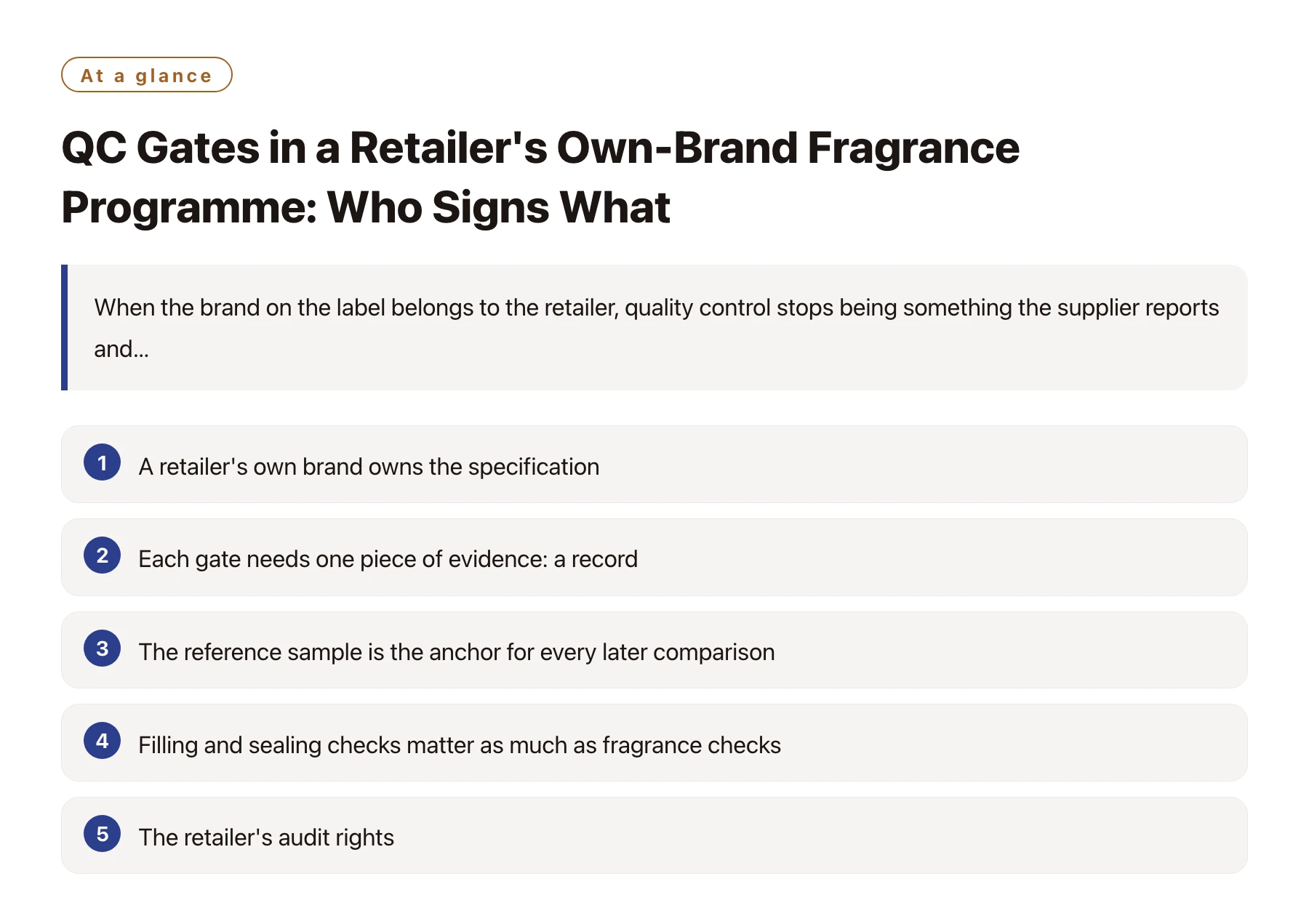
- A retailer's own brand owns the specification, so quality control checkpoints should be agreed in writing before the first sample is produced.
- Each gate needs one piece of evidence: a record, a retained sample or a signed approval, not a verbal confirmation.
- The reference sample is the anchor for every later comparison, so it must be retained, sealed and dated by both parties.
- Filling and sealing checks matter as much as fragrance checks, because a perfect liquid in a leaking pack is a failed batch.
- The retailer's audit rights, including access to batch records, belong in the contract rather than in an email thread.
Fragrance OEM/ODM manufacturing services are usually sold on capability: development, compounding, filling, decoration, packing. Quality control is presented as part of that package, and it is - but the accountability does not transfer with it.
For a retailer's own brand the practical question is not whether the factory has a quality system. It is which checkpoints the retailer signs off, what evidence closes each one, and what happens when a check fails after the goods have left the factory.
What quality control means when the label is yours
On a licensed brand, a quality disagreement is often resolved between the brand owner and the manufacturer, and the retailer is a channel. On an own brand, the retailer is the brand owner, which means the retailer's name is on the recall notice. That single change moves quality control from a supplier activity to a shared activity with the retailer holding final authority.
This is why a written specification matters more than a certificate list. Certificates describe the system a factory operates; a specification describes what your batch must be. Buyers who ask for both, and who check that the specification carries numeric tolerances for fill volume, alcohol content and pack integrity, generally find that disputes become shorter and less frequent. Destination-market rules also shape what the specification must carry, and those rules are not uniform across markets [2].
Where the manufacturing partner also runs development, as Xuelei does across its OEM and ODM work, the specification can be written while the formula is still moving. That is the cheapest moment to set tolerances, because the development bench still has a reason to test them.
Six checkpoints and the evidence that closes each one
| Checkpoint | What the retailer checks | What the factory should be able to show |
|---|---|---|
| Brief and specification | That tolerances, dosage, fill volume and pack requirements are numeric and signed | A specification document with revision history, not a summary email |
| Bulk approval | That the bulk matches the approved reference in odour, colour and clarity | A retained bulk sample, a batch record and the dated approval |
| Resting and stability | That the resting period was observed and the pack ageing result is acceptable | Resting log plus stability observations on the actual pack [1] |
| Filling and sealing | Fill weight, crimp or pump torque, leakage and spray function on the line | In-process checks with sample size and the action taken on any fail |
| Decoration and packing | Print position, colour match, label text and carton count | First-article approval and the measured result, not a photo alone |
| Release | That the finished batch record is complete before goods ship | A signed release note linked to the batch number that travels with the shipment |
Notice that none of these gates asks the factory to promise quality. Each one asks for a record that can be inspected later, which is the only form of quality assurance that survives a change of account manager on either side.
Where own-brand QC differs from licensed-brand QC
The differences are practical rather than philosophical, and they show up in three places: who approves, who stores, and who can audit. One thing does not change: the formula still has to sit inside the ingredient restrictions that apply to fragrance materials, and the retailer should be able to see which restriction list the formula was built against [3]. Asking for that list at the specification stage is a five-minute question; asking for it after a compliance query from a market is a project.
The retailer approves. A factory that has spent years serving brand owners may expect the brand owner's development team to sign the bulk. On an own brand there may be no such team, so the approval has to come from a named person in the buying or quality function, with a deputy named in case of absence. Programmes stall more often on an unavailable approver than on a failed test. Where a factory acts as a fragrance OEM/ODM production partner rather than a pure filler, it can usually supply a draft specification and a draft gate list, which the retailer then edits rather than writes from scratch.
The retailer stores. Reference samples must be kept somewhere that is not the factory's own archive, ideally with the retailer or with an agreed third party. A reference sample the supplier holds is still useful, but it is not independent, and independence matters if an odour complaint arrives six months after delivery.
The retailer audits. Access to batch records, retained samples and the compounding area should be written into the agreement before the first purchase order. Own-brand buyers who wait until a problem appears often find the audit clause is the one clause nobody negotiated, and that the conversation is now happening while goods sit in a warehouse.
Running the gates without slowing the programme
- Write the specification firstOne page with numeric tolerances is enough to turn every later conversation into a yes or no question.
- Name two approvers per gateA primary and a deputy, both briefed before the programme starts, so a holiday does not become a delay.
- Fix the evidence formatAgree the record template in advance; free-format reports are hard to compare across batches.
- Retain samples in two placesKeep one reference set with the retailer and one at the factory, both sealed and dated at the same time.
- Review failures as a pairEvery failed check should produce a written cause and a written change, even when the batch is accepted after rework.
- Close the file at shipmentThe batch record, release note and shipping documents should leave together, not in a follow-up email weeks later.
The paperwork that keeps working after launch
Quality control checkpoints are usually designed for the pre-launch period, then abandoned once the range is on shelf. That is a mistake for a retailer's own brand, because the useful life of the file is the life of the product. A complaint eighteen months after launch is answered from the batch record, the retained sample and the stability observations, or it is not answered at all.
It is worth confirming that the manufacturer keeps records for the period your market requires, and that the retention obligation survives the end of the commercial relationship. A manufacturer such as Guangzhou Xuelei that works with many own-brand programmes will usually have a retention policy already written down, which shortens the conversation considerably. A short clause covering record retention and the transfer of records on termination is inexpensive to agree and expensive to retrofit.
Before signing, it also helps to look at how the supplier presents finished work rather than what it claims about process. Reviewing examples of fragrance projects and asking which checkpoints were used on each one tests whether the quality language used in the pitch matches the records the factory actually keeps. A supplier that can walk through one project gate by gate is easier to trust than one that answers with a certificate folder.
A certificate proves that a system exists. A batch record proves that the system was used on your order. Retail own-brand buyers need both, but when only one is available, the batch record is the one that answers a complaint.
Sources
- SGS: Cosmetics, Personal Care & Household Testing —— Testing, inspection and certification services for cosmetics and personal care, including microbiological, stability and safety testing aligned with cosmetics GMP.
- European Commission: Cosmetics in the EU —— The European Commission's overview of EU cosmetics rules, including the responsible person, product information file and safety report requirements.
- IFRA: Safe Use and Fragrance Science —— IFRA's explanation of how fragrance materials are scientifically assessed for safe use and how those conclusions are applied by the industry.
Frequently asked questions
How many quality control checkpoints should a retail own-brand fragrance order have?
Six is a workable number for most first orders: specification, bulk approval, resting and stability, filling and sealing, decoration and packing, and release. More gates dilute attention; fewer leaves a gap that is usually discovered at the filling line or in the store.
Who should hold the reference sample?
Both parties should hold one, sealed and dated at the same time. The retailer's copy is the independent one used to settle complaints; the factory's copy is the working one used to set up production. One sample held only by the supplier is not sufficient evidence for an own-brand dispute.
Do fragrance OEM/ODM manufacturing services include stability testing?
They usually include it as an activity, with the scope depending on the market and the pack. What matters is that the results are documented on the actual container being sold, not on a laboratory bottle, and that the retailer receives the report rather than a summary of it.
What if our factory fails a checkpoint after shipping?
The contract should already say. Practically, the retailer needs batch records to define the affected population, a retained sample to confirm the deviation, and an agreed remedy ladder covering rework, replacement or credit. Negotiating that ladder after a failure is the worst possible time to start.
Can a smaller retailer run these gates without a quality team?
Yes, but the gates have to be fewer and more explicit. The usual approach is to delegate day-to-day checking to the manufacturer while retaining two decisions in house: approval of the reference sample and release of the finished batch. Both decisions need one named person and a deputy.